
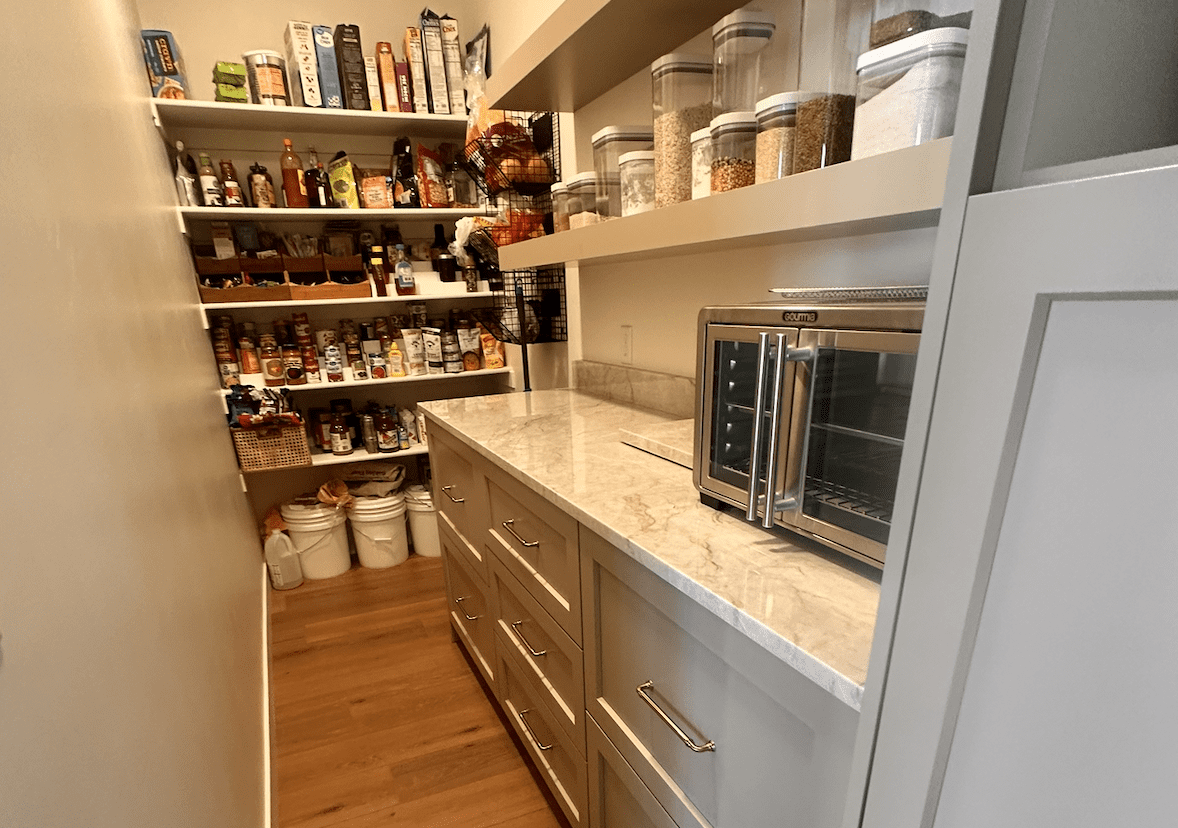
A real Cache Valley pantry has to hold up to things a Pinterest pantry never sees. The hundred-pound bag of flour from the Honeyville buying group. Three flats of canned peaches from the neighbor's orchard. A year of home-bottled jam. Five Costco bulk packs of pasta. The deep freezer overflow that ends up in cardboard boxes on the floor. At Rivermill Cabinets & Woodworks in Hyde Park, Utah, we build pantries for families who actually cook, bottle, store, and feed — not just display.
Over 20 years of building pantries across Cache Valley, we've learned what works and what falls apart by the second Thanksgiving. Here's what to think about before you build yours.
Walk-In, Cabinet, or Butler's Pantry: What Actually Fits Your House
The first decision is what kind of pantry the home can support. These are the three formats we build most often, and the call is usually dictated by square footage and kitchen layout more than taste.
- Walk-in pantry. A dedicated room, typically 4x6 to 8x10 feet, with fully custom shelving and usually a small counter. This is the right call for the new construction we're seeing in Providence, Nibley, North Logan, and Hyde Park — the floor plans are built for it. A walk-in pantry gives you room to stage bulk storage, a landing zone for Costco runs, and vertical space for canning jars.
- Cabinet pantry. A tall run of full-height cabinetry, usually 24 to 36 inches deep, built into the kitchen wall. This is the workhorse for older Logan, Smithfield, and Hyrum homes where a dedicated room isn't possible. Done right with pull-out shelves and internal drawers, a well-designed cabinet pantry can hold more than a poorly designed walk-in.
- Butler's pantry. A transitional space between the kitchen and dining room with counter space, cabinetry, and sometimes a sink, wine fridge, or second dishwasher. We build a handful every year, usually in larger homes in Providence or on the east bench of Logan. It's less about bulk storage and more about entertaining, staging, and getting the mess out of the main kitchen when the extended family comes over.
The Four Zones Every Working Cache Valley Pantry Needs
When we sit down with homeowners at our Hyde Park showroom, we stop talking about "shelves" and start talking about zones. A pantry that functions the way you actually live is built around how often you reach for each item, not how it looks on a shelf.
- The daily zone. Eye-level and waist-level shelves for the cereal, snacks, bread, and everything the kids can reach. This is where pull-out drawers shine — they turn a dead back corner into usable space and stop the forgotten-can graveyard.
- The weekly zone. Mid-height adjustable shelves for staples — flour, sugar, rice, canned goods in regular rotation. We usually spec this at 12 to 14 inches deep so cans sit one row deep and you can actually see what you have.
- The bulk zone. Heavy-duty lower shelves or a dedicated floor pocket for bags of flour, rice, and oats from the Honeyville co-ops, plus wholesale cases from Costco or Sam's Club in North Logan. Minimum 18 inches deep and rated for real weight. This is where most retail pantries fail — particleboard shelves sag within a year.
- The specialty zone. Top shelves or a separate cabinet bay for home-canned jars, holiday dishes, the turkey roaster, and everything you only reach for a few times a year. For Cache Valley families who bottle peaches, salsa, or apple pie filling from the backyard harvest, we often build a dedicated jar wall with 4-inch-deep shelves so every jar has a front-row seat.
Sizing a Pantry for a Family That Buys in Bulk
Cache Valley families tend to run larger than the national average, and the storage culture here is real — whether it's long-term food storage in the basement, bottled fruit from the backyard, or the gallon of milk that gets hauled home from Maceys or Lee's twice a week. That changes how we size.
For a family of five to seven in Richmond, Hyrum, or Wellsville, we typically recommend a minimum 5x7 walk-in, or 8 linear feet of full-height cabinet pantry. For the newer, larger homes going up in Providence and Nibley, 6x10 walk-ins are becoming standard — with enough room for a small counter, a second refrigerator, and dedicated canning jar storage. For a 1960s or 70s rambler in Smithfield, Mendon, or central Logan, we often convert a closet or reconfigure a nearby laundry space into a 4x5 cabinet pantry that punches well above its weight.
Best Materials, Shelving, and Hardware for a Working Pantry
A pantry doesn't take the abuse a Cache Valley mudroom does, but it has its own specific demands — heavy loads, the occasional spilled bottle of vinegar, and shelves that have to stay flat under 40 pounds of canned goods. Here's what we build with.
- Shelf material. 3/4-inch plywood with a hardwood edge band. Particleboard shelving will sag under a full load of canned tomatoes within 18 months — that's not a theoretical problem, it's the most common pantry repair we're called out to fix on homes we didn't build.
- Adjustability. Every shelf on adjustable pins at minimum, with heavy-duty 1/4-inch pins rather than the flimsy plastic ones. Families change what they buy over time — a pantry that's locked in at one configuration dates fast.
- Pull-outs. Full-extension, soft-close Blum drawer slides rated to 100 pounds minimum. For canned goods and bulk bags, this is non-negotiable. Standard 75-pound slides fail fast under Cache Valley-sized pantry loads.
- Finish. Paint-grade maple with conversion varnish or a durable catalyzed lacquer. Wipes clean, handles the occasional spill, and doesn't yellow in the low-humidity Cache Valley winters the way lower-grade finishes do.
- Lighting. LED strip lights under every shelf edge. Walk-in pantries without good lighting turn into dim caves where nothing gets found — which is how food goes to waste and then to the compost pile.
Small-Space Pantry Ideas for Older Homes
Not every house has room for a walk-in, and that's fine. The best pantry we built last year was a 5-foot-wide reach-in tucked behind a pocket door in a 1970s Smithfield rambler. It had more usable storage than most 8x8 walk-ins we see in newer homes, because every cubic inch was designed around what the family actually owned.
In older Logan homes near USU, in Wellsville, and in tight floor plans we see in some parts of Hyrum, we've had good luck with three approaches: converting a coat closet into a floor-to-ceiling pantry with a pull-out shelving tower, building a 24-inch-deep cabinet pantry bank along a laundry-room wall, or adding a shallow 10-inch "spice and can" pantry between studs when a wall can be opened up. Small pantries are where good design matters most, and also where we see the biggest difference between stock cabinetry and real custom work.
What It Costs and How Long It Takes
A custom pantry from our Hyde Park shop typically runs $3,500 to $9,500 in Cache Valley for a well-equipped cabinet pantry or a modest walk-in build-out, and $10,000 to $22,000 for a full walk-in with counters, a jar wall, and premium hardware. A true butler's pantry with stone counters and appliances runs higher — usually $15,000 and up.
Timeline is typically 5 to 8 weeks from signed design to installed cabinetry. For families planning ahead of the fall canning season or a holiday hosting year, we recommend booking the design conversation by midsummer so installation lands before Labor Day.
Questions to Ask Before You Build
Whether you hire us or someone else, a pantry is one of the easiest places to get sold something that looks good on day one and fails in year two. These are the questions we'd want a homeowner to ask.
- What are the shelves actually made of? 3/4-inch plywood is the floor. Anything thinner or made of particleboard will sag under real grocery weight.
- What's the drawer slide rating? For a working pantry, 100-pound full-extension slides. Less than that and pulls get harder to open over time.
- Are the shelves adjustable? Fixed shelves age fast. Every working pantry should let you move shelves as what you buy changes.
- Is there dedicated bulk storage? A pantry with no plan for 25-pound bags or case goods isn't designed for how Cache Valley families actually shop.
Let's Design a Pantry That Matches How You Actually Shop
Rivermill Cabinets & Woodworks is at 50 S Main Street in Hyde Park — five minutes from Logan and ten from Smithfield. Every pantry we build is designed, measured, and built in our shop for the way a specific family cooks, bottles, and stores. If you're ready to stop losing groceries in the back of a dark shelf, visit our showroom or contact us to start the conversation. We'll help you map out zones, size the build, and deliver a pantry that finally keeps up with the way you feed your family.


