
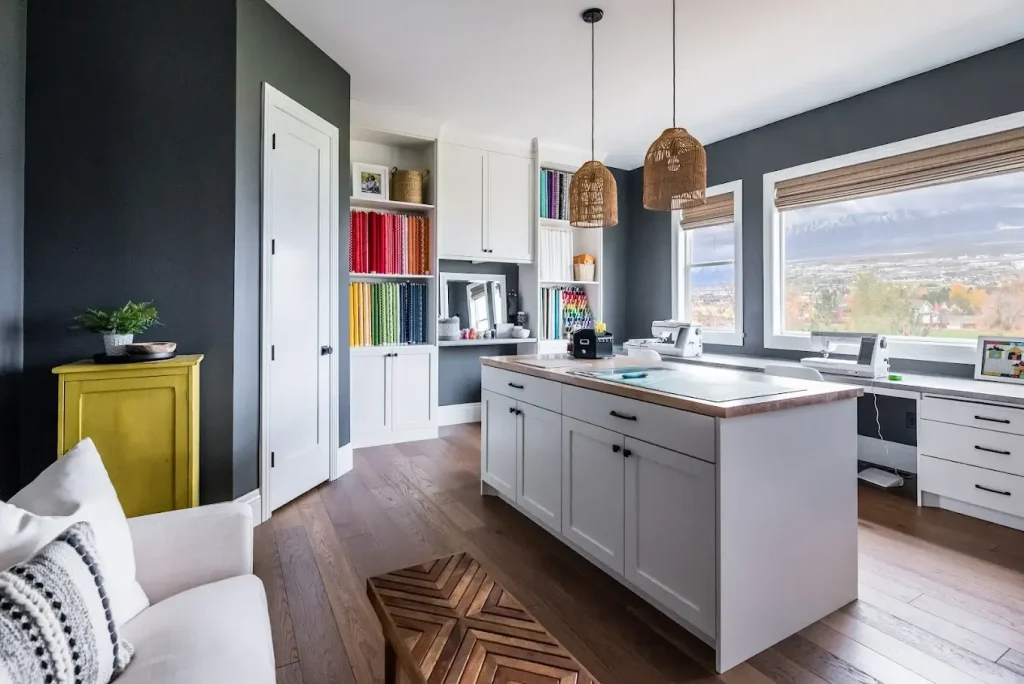
If you sew, quilt, scrapbook, or run a small craft business out of your home, you already know the problem: the hobby grows faster than the space. Fabric ends up in tubs in the basement, rulers live in a drawer with the tape, and the cutting table is also the dinner table. Across Cache Valley, from Logan and North Logan to Hyde Park, Smithfield, and Providence, more homeowners are asking us how to turn a spare bedroom, basement corner, or bonus room into a craft room that actually works. This guide covers the questions we hear most, answered the way a working cabinet shop sees them.
What Makes a Good Craft Room Cabinet Layout?
A craft room is a workflow, not a closet. The best layouts follow the order you work in: store, cut, sew or assemble, press, finish. We usually split the room into three zones, then build cabinets to fit each one.
- Storage wall. Tall cabinets or a full wall of uppers and lowers for fabric, yarn, paper, and project bins. Keep the heaviest items between knee and shoulder height.
- Cutting and layout zone. A freestanding or built-in island with drawers underneath, sized so you can reach the center from both sides.
- Machine and pressing zone. A lowered sewing station and a separate counter-height pressing area, so you are not constantly changing posture.
Before we draw anything, we ask what you make most. A quilter who handles yardage needs a very different room than a scrapbooker with thousands of small paper sheets, and a custom shop can build for the exact projects you do instead of a generic organizer.
How High Should a Cutting Table or Craft Island Be?
This is one of the most searched craft room questions, and the honest answer is that it depends on your height and your back. Standard kitchen counters sit at 36 inches, and that is a good starting point for a cutting surface because you can stand upright and keep your wrists neutral while using a rotary cutter. Many quilters in the 5’2″ range prefer 34 to 35 inches; taller crafters often go to 38 inches.
A few details that make a real difference on a craft island:
- Depth of 30 to 36 inches lets you lay out a folded yard of fabric and still reach across.
- A 1-1/2 inch thick top with a square or lightly eased edge so rulers sit flat and nothing catches.
- Shallow drawers on top, deep drawers below. Rulers, rotary cutters, and scissors want 2 to 3 inch drawers; batting and project bags want 10 to 12 inch drawers.
- Locking casters or a fixed base. We almost always recommend a fixed base so the table never shifts mid-cut.
How Do You Store Fabric So It Doesn’t Fade or Get Musty?
Fabric storage is where cabinets earn their keep. Open shelving looks great in photos, but fabric left in sunlight fades fast, and Cache Valley sits at roughly 4,500 feet where UV exposure is stronger than most people expect. A south- or west-facing room in Hyrum or Wellsville can bleach the top fold of a stack in a single season. Closed doors are the answer, with a few smart tricks inside:
- Shelves spaced for folded yardage. Plan on 9 to 12 inch spacing for fabric folded over comic-board or small bolts, and adjustable shelf pins so you can change it later.
- Depth of 14 to 16 inches. Standard 12 inch wall cabinets are too shallow for fat quarters and folded yardage, so we often build craft uppers a little deeper than a kitchen upper.
- Solid wood or quality plywood boxes. Raw particleboard and some low-grade finishes can off-gas and, in damp basements, pick up odor. A sealed, finished interior keeps stored fabric clean.
- Pull-out shelves for deep lowers. Nothing gets lost in the back of a base cabinet when the whole shelf rolls out to you.
Our dry winters cut both ways. Low humidity is good news for fabric and paper, which can mildew in damper climates, but it also means static and lint, so cabinets with tight-fitting doors help keep dust off your stash. We also recommend a well-sealed finish inside the cabinets so stored items stay clean.
What Are the Best Storage Ideas for Thread, Rulers, and Small Tools?
Small tools are where store-bought organizers fall apart. Because we build cabinets to your measurements, we can design around the tools you actually own. Popular requests from Cache Valley crafters include:
- Vertical ruler and template slots. Narrow dividers in a tall, thin cabinet keep acrylic rulers upright and unscratched, usually in a space only 6 to 8 inches wide.
- Thread and notion drawers. Shallow drawers with custom inserts sized to your spool brand, so nothing rolls around.
- Pegboard-style backs or French cleats. Hanging scissors, rotary cutters, and hoops on the inside of a door frees up counter space.
- Paper and vinyl storage. Wide, shallow drawers for 12 by 12 inch scrapbook paper, or vertical cubbies for vinyl rolls.
- Pull-out cart bays. Room for a rolling cart that tucks under the island and comes out for large projects.
Can a Craft Room Fit in a Basement, Spare Bedroom, or Small Space?
Absolutely, and in this valley that is usually where it happens. Many of the homes we work in, from 1970s split-levels in North Logan to newer builds in Nibley and Richmond, have finished basements with a spare room that suits a craft space well. Lower light levels are actually friendly to fabric, as long as you plan good task lighting. A few common situations:
- Spare bedroom. A wall of floor-to-ceiling cabinets with doors that close on the mess makes the room feel like a bedroom again when guests arrive.
- Basement corner. Cabinets that run to the ceiling use the full height, and a built-in desk makes the corner feel intentional.
- Shared family room. A craft cabinet with a fold-down work surface closes up into what looks like a normal built-in.
If you are working with a builder or local GC on a new home in Providence or Smithfield, tell them early that you want a craft room. Outlets, floor circuits for a sewing machine and iron, and lighting all need to be planned before drywall goes up, and that is far easier than retrofitting.
What Lighting and Power Does a Craft Cabinet Need?
Good lighting reduces eye strain and makes color matching accurate. We build cabinets with under-cabinet LED strips in neutral white, and we leave space for outlets in the island and the back of the work surface. For a sewing zone, plan at least two outlets within reach, one for the machine and one for the iron or lamp. Daylight-balanced bulbs of 4000 to 5000 Kelvin are a good choice if you match colors for quilting.
Questions to Ask Any Cabinet Maker Before Building Your Craft Room
A craft room is not a standard kitchen job, so ask these before you sign anything:
- Can you build to my tool and fabric sizes? A good shop will ask you to bring your rulers, a sample stack of fabric, and a sketch of your workflow.
- What are the boxes made of? Ask for plywood or solid wood construction rather than basic particleboard if you will be storing heavy items.
- How do you handle our dry climate? A shop that has built in Cache Valley for years will understand wood movement, humidity swings, and finishes that hold up.
- Will you visit the room and measure? Basement walls and older floors are rarely square, and cabinets need to be scribed to fit.
- Who installs? Having the same crew build and install means fewer surprises.
At Rivermill, we have spent more than 20 years building cabinetry for homes across Cache Valley, and we handle design, building, and installation from our shop at 50 S Main Street in Hyde Park. We are happy to review photos of your room, talk through your projects, and help you decide what to build first.
Ready to Plan Your Craft Room?
If you are in Logan, Hyde Park, Smithfield, Providence, Nibley, North Logan, Richmond, Hyrum, Wellsville, or Mendon and want a craft room built around how you actually work, we would love to hear about it. Bring your tools, your fabric stash, and your wish list, and visit our showroom or contact us to start the conversation.


