
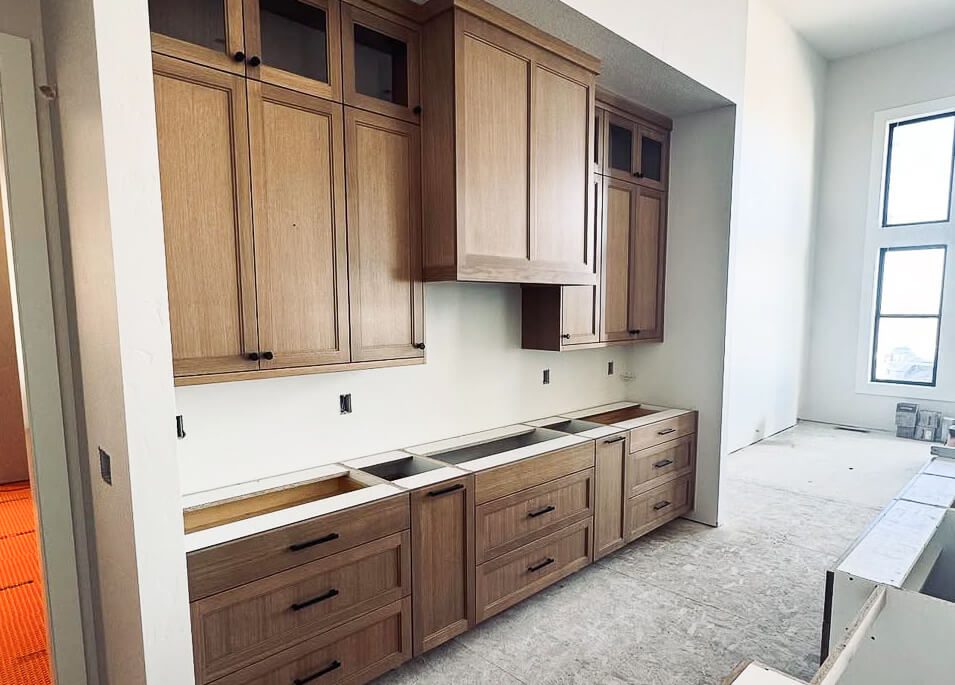
Custom kitchen cabinets in Utah are not a one-size-fits-all conversation. A new construction home in Lehi has different needs than a 1970s remodel in Smithfield, a mountain cabin in Park City, or a desert build near St. George. Climate, home style, building regulations, and even regional design trends vary meaningfully across the state. At Rivermill Cabinets & Woodworks in Hyde Park, Utah, we build custom cabinetry for Utah homeowners — and while our core service area is Cache Valley and northern Utah, we’ve spent 20 years understanding what makes each Utah market different.
This is the overview of what Utah homeowners should think about before starting a custom cabinet project. For homeowners specifically in the Logan and Cache Valley area, we’d point you to our detailed guide to custom kitchen cabinets in Logan, Utah — that’s where the local specifics live.
Utah’s Four Custom Cabinet Markets
Utah isn’t one market for custom cabinetry. It’s four, and they behave differently.
- The Wasatch Front. Salt Lake City, Sandy, Draper, and the Utah Valley corridor through Provo and Orem. Large volume of new construction, high competition among cabinet shops, and price pressure from big-box and semi-custom resellers. Homeowners here often have access to the widest range of suppliers but need to work harder to verify whether a “custom” quote is actually custom or just a semi-stock modification.
- Cache Valley and northern Utah. Logan, Smithfield, Providence, Nibley, Hyde Park, and the surrounding agricultural valley. A mix of older homes that need remodel work and new construction in the growing communities south of Logan. Smaller pool of cabinet shops, closer relationships with local general contractors, and higher homeowner tenure — people stay in their homes longer, which shifts the math toward quality custom work over stock replacements.
- Park City and the mountain corridor. Second homes, mountain cabins, and high-end new construction along the Wasatch Back. Rustic materials are often specified — knotty alder, hickory, rift-sawn white oak — along with heavier hardware and darker finishes. Budgets are typically higher and expectations for showcase kitchens are significant.
- Southern Utah. St. George, Cedar City, and the desert communities. Drier air and more intense UV exposure affect material choices differently than in the north. Painted finishes require better UV resistance, and wood species prone to heavy movement in low humidity get ruled out fast.
What “Custom” Actually Means in Utah
The word “custom” gets used loosely in the cabinet industry, and Utah is no exception. Before you sign a quote, make sure you know which category you’re actually buying.
- Stock. Prebuilt cabinets from a national manufacturer, ordered in fixed sizes and finishes. Cheapest option, widest retail availability, but often built with particleboard boxes, factory finishes that etch under hard water, and no accommodation for the actual dimensions of your kitchen. Fine for rentals, not ideal for a home you plan to stay in.
- Semi-custom. Factory cabinets with some modification options — sizes can be adjusted within limits, certain door styles and finishes are available. Better than stock, significantly cheaper than true custom, but you’re still working within the factory’s constraints, not your home’s.
- True custom. Cabinets designed to your exact dimensions and built in a local shop, with materials, construction methods, and finishes chosen for your project. The only option that handles non-standard dimensions, irregular wall angles, tall Utah ceilings, or unusual storage requirements without compromise. Longer lead time, higher price, significantly better end result.
How Utah’s Climate Shapes Material and Finish Choices
Utah’s climate is unusually hard on cabinetry, and national-average material recommendations don’t always apply here.
Most of the state sits at elevation — 4,200 feet in St. George, 4,500 feet in Cache Valley, over 7,000 feet in Park City — which means drier air, bigger humidity swings between winter and summer, and more intense UV exposure through south-facing windows. Those three factors change which wood species work, which finishes hold up, and which construction methods survive.
- Wood species for Utah. Paint-grade maple and poplar are workhorses — stable, paintable, and largely immune to the 30–50% humidity swings common in Utah. For stained finishes, knotty alder, hickory, white oak, and walnut are the most common choices. Cherry is beautiful but darkens faster under Utah’s UV than in lower-elevation climates.
- Finishes for Utah. Conversion varnish and catalyzed lacquer are the gold standard. Both resist water, cleaners, and UV better than factory finishes, and they age more gracefully — especially important in homes that see significant direct sun.
- Box construction for Utah. 3/4-inch plywood boxes handle seasonal movement. Particleboard will swell, warp, or crack under Utah’s humidity swings, particularly in homes near water features, on lakefront lots, or in areas with basement moisture issues.
Timeline and Process: What to Expect in Utah in 2026
A true custom cabinet project in Utah typically runs 6 to 12 weeks from signed design to installed cabinetry. The variables:
- Design and measure. 1 to 3 weeks. Most reputable Utah cabinet shops will visit the home, take detailed measurements, and produce drawings before a final quote.
- Build. 4 to 7 weeks in shop, depending on project size and current backlog. Spring and early summer are peak season across Utah — book earlier to get on the calendar.
- Installation. 1 to 5 days on site, depending on size and complexity. A full kitchen usually installs in 2 to 3 days.
Cost Expectations for Custom Cabinets in Utah
Cost varies meaningfully by region within Utah, but reasonable 2026 expectations for a full custom kitchen cabinet project are:
- Entry-level custom. $20,000 to $35,000 for a standard-sized kitchen with paint-grade maple, straightforward door styles, and mid-range hardware.
- Mid-range custom. $35,000 to $65,000 with upgraded wood species, premium hardware, more complex layouts, or specialty features like built-in hood surrounds, appliance garages, or islands with integrated seating.
- High-end custom. $65,000 and up for large kitchens, premium materials throughout, inset doors, and the kind of detail work that defines a showcase kitchen.
Cache Valley tends to run at the lower end of these ranges; Wasatch Front and Park City tend to run higher. Southern Utah sits in between.
How to Pick a Cabinet Maker in Utah
The quality gap between Utah’s best custom cabinet shops and the ones that will sell you “custom” labels on imported semi-stock boxes is significant. Four questions separate the two:
- Where are the cabinets built? A real custom shop builds in-house, in Utah. If the answer involves a factory in another state or overseas, you are buying semi-custom at best.
- What’s the box material? 3/4-inch plywood is the right answer for Utah. Particleboard is a red flag.
- Who handles installation? Ideally the cabinet maker, or a dedicated installer they work with exclusively. Subcontracted installation is where most field problems originate.
- What’s the warranty and service relationship? Local shops stand behind their work decades after the install. Reseller operations often can’t.
Where Rivermill Fits: Serving Northern Utah and Cache Valley
Rivermill Cabinets & Woodworks is based at 50 S Main Street in Hyde Park, Utah — the center of Cache Valley, just north of Logan. Our core service area is northern Utah: Logan, Smithfield, Providence, Nibley, North Logan, Richmond, Hyrum, Wellsville, Mendon, and the communities along the valley floor. We’ve been building custom cabinetry from this location for over 20 years.
For homeowners in Cache Valley specifically, the most detailed local resource we have is our homeowner’s guide to custom kitchen cabinets in Logan, Utah. For homeowners elsewhere in Utah, the same principles in this overview apply — the climate, the material choices, and the questions to ask any cabinet maker translate statewide. Where the specifics get interesting is when you pick a region and a project, which is why our design conversations always start with the house, not a catalog.
Start the Conversation
If you’re planning a custom kitchen in Utah and want a second opinion from a shop that has built across the state’s climate zones and design traditions, visit our showroom in Hyde Park or contact us. We’ll help you work through the material choices, timeline, and budget — and either build the project ourselves or point you to the right specialist for your region.


