
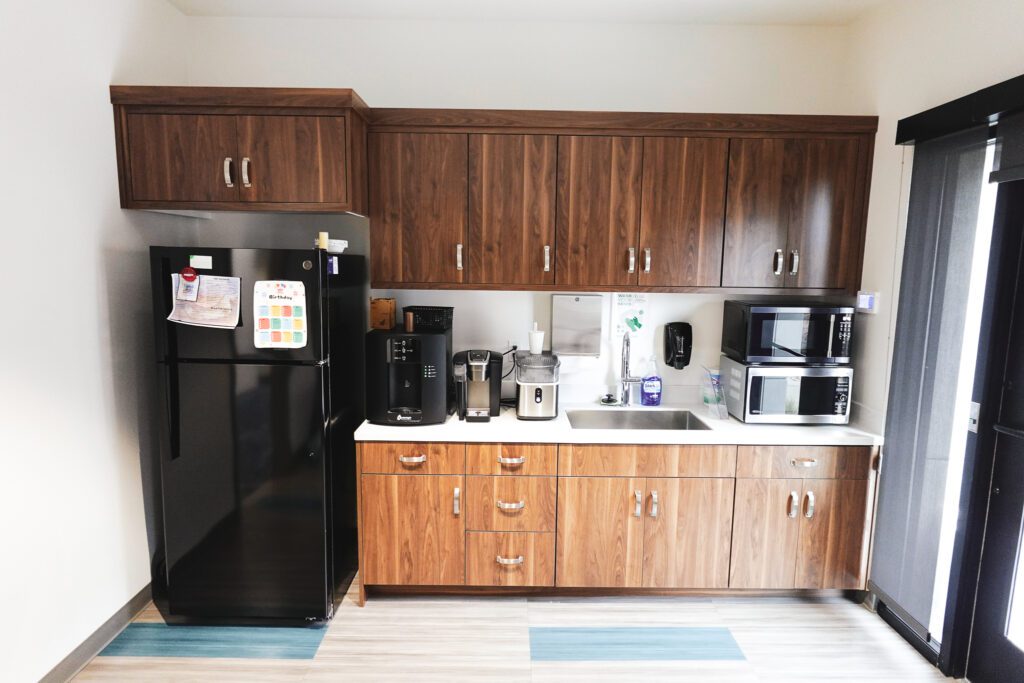
If you have started shopping for kitchen cabinets in Cache Valley, you have probably run into two terms that nobody bothers to explain: framed and frameless. They describe how a cabinet is actually built — the box itself, not the door style or the stain — and the choice quietly shapes how your kitchen looks, how much it holds, and how well it survives twenty Northern Utah winters. At Rivermill Cabinetry & Woodworks, we have spent more than 20 years building both in our Hyde Park shop, and the right answer depends a lot on how you live in your home.
What is the difference between framed and frameless cabinets?
Every cabinet starts as a box. The difference is what happens at the front edge of that box.
- Framed (face-frame) cabinets. A flat hardwood frame — usually about 1.5 inches wide — is attached to the front of the box, like a picture frame around the opening. Doors and drawers mount to that frame. This is the traditional American method, and it is what most older homes in Logan and Smithfield already have.
- Frameless (full-access) cabinets. There is no front frame. The doors mount directly to the sides of the box, so the opening is nearly as wide as the cabinet itself. This is the European method, sometimes called “full-access” construction, and it has become the default look in newer builds across Providence and Nibley.
Both can be built beautifully and both can be built badly. The label tells you the construction approach, not the quality — which is exactly why it pays to understand what each one does for you before you sign off on a design.
Framed cabinets: the traditional, time-tested choice
The face frame does real structural work. It stiffens the box, gives the doors a solid surface to hinge against, and makes the cabinet forgiving to install on the slightly-out-of-square walls you find in older homes around Hyrum, Wellsville, and Mendon. When a 1970s ranch in Smithfield has settled a half inch over fifty years, a face-frame cabinet lets our installers shim and scribe everything back to plumb without the gaps showing.
Framed construction also opens up the classic detailing a lot of Cache Valley homeowners want: inset doors that sit flush inside the frame, beaded face frames, furniture-style end panels. If your goal is a warm, traditional kitchen that looks like it belongs in a valley full of century-old farmhouses, framed cabinets get you there naturally.
The one trade-off is the center stile — the vertical strip of frame between a pair of doors. It takes up a little reach-in width and can make it harder to slide a wide stockpot or a sheet pan straight in. For many families that is a non-issue. For someone planning around big-batch cooking and food storage, it is worth weighing.
Frameless cabinets: full access and maximum storage
Without a face frame eating into the opening, frameless cabinets give you roughly 10 to 15 percent more usable space inside the same footprint, and the openings are wider top to bottom. For the large families that are common across Cache Valley, that difference is real: deeper drawers that actually hold a full set of mixing bowls, wide pull-outs that swallow a year’s worth of canning jars, and no center stile blocking the opening.
Frameless also reads cleaner and more modern. The doors sit close together with thin, even gaps — the streamlined look that fits the contemporary new construction going up in North Logan and the benches above Providence. Pair it with slab or flat-panel doors and you get the crisp, European feel many younger buyers are after.
The catch is that frameless construction is less forgiving. With no frame to absorb irregularities, the box itself has to be dead square and the material has to be stable, because the door alignment depends entirely on the box staying true. That is a manufacturing-precision question — and it leads straight into the part that matters most here.
Which holds up better in Cache Valley’s dry climate?
This is where local conditions stop being a footnote. Cache Valley sits at roughly 4,500 feet, and our winters are punishingly dry — indoor humidity routinely drops into the teens once the furnace runs from November through March. Wood moves when humidity swings that hard, and how a cabinet is built determines whether that movement shows up as a problem.
- Box material matters more than the frame debate. A 3/4-inch furniture-grade plywood box stays dimensionally stable through our humidity swings far better than thin particleboard, whether it is framed or frameless. Ask what the box is made of before you ask about anything else.
- Frameless demands precision in dry air. Because alignment relies on a perfectly square box, frameless cabinets built from unstable material are the first to show sagging doors and uneven gaps after a dry Logan winter. Built correctly from stable stock, they hold up beautifully.
- Hard water meets hardware. Cache Valley’s hard water and mineral-heavy air are tough on cheap hinges and slides. We spec corrosion-resistant, six-way adjustable hinges and full-extension undermount slides on both construction types so doors can be re-trued years down the road.
- Elevation and UV. Strong high-altitude sunlight fades finishes near big south-facing windows. The construction method does not change that, but a quality catalyzed finish — which we apply in the shop — protects either style from our intense valley light.
The honest takeaway: in our climate, the framed-versus-frameless decision is mostly about look and storage. The thing that actually decides whether your cabinets stay tight and true for decades is the material and the joinery underneath, not which front-edge style you picked.
How the choice affects storage, accessibility, and daily life
Think about who uses the kitchen. Multigenerational households and homeowners planning to age in place — a real consideration in the established neighborhoods of Wellsville and Richmond — often benefit from frameless drawers and pull-outs, because the wide, unobstructed openings are easier to reach into without bending and twisting around a center stile.
Families running a busy household with food storage, bulk shopping, and a lot of baking tend to value the extra interior volume frameless provides. On the other hand, if you love the look of a traditional inset kitchen and you are restoring character in an older Logan or Hyde Park home, framed construction is usually the more authentic fit. Plenty of our Cache Valley projects mix both: framed perimeter cabinets for warmth, a frameless island or pantry bank where raw capacity counts.
Questions to ask any cabinet maker before you choose
Whether you build with us or someone else, these questions separate a shop that builds to last from one that does not:
- What is the cabinet box made of? You want furniture-grade plywood, not thin particleboard, especially in our dry climate.
- How are the drawer boxes built? Look for solid-wood, dovetailed drawer boxes on undermount, soft-close, full-extension slides — not stapled boxes.
- Do you build framed, frameless, or both? A true custom shop builds both and recommends based on your home, not on the one method it happens to own equipment for.
- Are the cabinets built and finished here? Locally built, shop-finished cabinets let you adjust for the exact dimensions and quirks of your Cache Valley home.
- Can the hardware be adjusted later? Six-way adjustable hinges mean your doors can be re-aligned after the wood settles through its first dry winter.
If a salesperson cannot answer those clearly, that tells you more than any brochure will.
Build it right for your home and your climate
There is no universal winner between framed and frameless — there is only what is right for your kitchen, your family, and a valley that swings from dry winters to bright summers. For more than two decades, Rivermill Cabinetry & Woodworks has helped homeowners from Logan to Richmond, Smithfield to Nibley, figure out which approach fits and then build it to survive real Northern Utah life. Stop by our shop at 50 S Main Street in Hyde Park, bring your measurements and your questions, and let’s talk through it — visit our showroom and see the difference local craftsmanship makes.


