
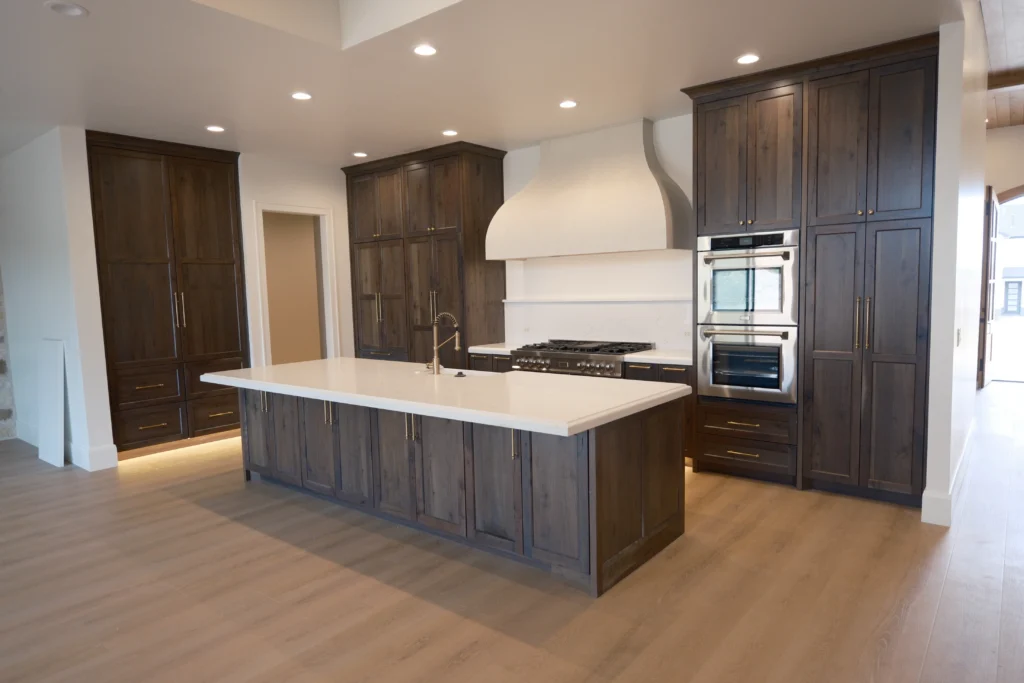
Walk through a Parade of Homes stop in Providence or a fresh remodel in Smithfield and you will see the same thing over and over: a painted perimeter with a stained wood island, or dark lowers under light uppers. Two-tone kitchen cabinets have gone from a bold choice to one of the most common requests we hear at our Hyde Park shop. They have also generated a very specific set of questions from Cache Valley homeowners, and the biggest one is simple: are two-tone kitchen cabinets still in style, or are we about to regret this?
After 20-plus years of building custom cabinetry for homes from Richmond down to Wellsville, here is our practical answer, along with the details that separate a two-tone kitchen that looks intentional from one that looks like a mistake.
Are Two-Tone Kitchen Cabinets Still in Style?
Yes, and the reason is that two-tone is not really a trend. It is a strategy. Kitchens have used contrasting islands and hutches for generations, and in 2026 the most common two-tone combinations in Cache Valley lean on materials that age well: natural white oak, rift-sawn oak, knotty alder, walnut, and warm neutral paints rather than high-contrast novelty colors.
What does go out of style is a specific pairing. Espresso lowers with stark white uppers reads as 2012. Gray-on-gray reads as 2018. A natural oak island with a soft cream or mushroom perimeter reads as timeless because both elements would look correct on their own. That is the test we use in our showroom: if you removed either color from the room, would the remaining kitchen still make sense? If yes, the combination will hold up.
The Two-Tone Combinations Cache Valley Homeowners Are Choosing
Every valley has its own palette. Ours is shaped by big windows facing the Wellsville Mountains, lots of natural light at 4,500 feet of elevation, and homes that range from 1970s split-levels in North Logan to new builds on the Nibley and Providence benches. These are the combinations we build most often right now:
- Painted perimeter, stained island. The most requested layout in Logan and Hyde Park. A soft white, greige, or sage perimeter with a white oak, walnut, or alder island. The island becomes furniture, and the perimeter recedes.
- Dark lowers, light uppers. Navy, forest green, or charcoal base cabinets under white or cream uppers. This anchors the room visually and hides scuffs from boots and kids at floor level, which matters in a farm kitchen in Mendon or Hyrum.
- Wood uppers, painted lowers. The reverse of the above. Rift-sawn white oak or walnut uppers over painted lowers put the warmth at eye level and pair well with a wood range hood.
- Accent zone only. A single tall pantry wall, coffee bar, or hutch in a contrasting finish while everything else stays one color. This is the safest entry point if you are nervous about commitment.
How to Do Two-Tone Kitchen Cabinets Without Regret
Most two-tone kitchens that go wrong fail on proportion, not color. A few rules we follow in the shop:
- Follow the 70/30 rule. One finish should cover roughly 70 percent of the cabinet faces and the second finish the remaining 30. A 50/50 split looks indecisive. An island in a 12-by-14-foot kitchen usually lands right at that 30 percent mark, which is why the painted-perimeter-plus-island approach almost always works.
- Break at a logical line. Change color at an island, a full-height pantry, a hood, or the countertop line, never in the middle of a run. If uppers and lowers are different colors, every upper must be one color and every lower the other, with no exceptions for a single cabinet.
- Share one undertone. A cool blue-gray paint next to an orange-toned alder stain will fight. Pull a paint chip and a stain sample into the same light and check that both read warm or both read cool. Our showroom keeps full-size door samples for this reason; small chips lie.
- Keep the door style identical. Two colors and two door profiles is too much. A Shaker door with a 2-1/4-inch stile in both finishes, or a slab door in both, keeps the room unified. Only the finish should change.
- Match the hardware, not the finish. Use one hardware finish across both cabinet colors. Brushed brass and matte black both bridge a painted-and-stained pairing well. Mixing hardware finishes on top of mixing cabinet finishes is where kitchens start to look busy.
What Cache Valley’s Climate Does to a Two-Tone Kitchen
This is the part most national design blogs skip, and it is the part that matters most here. Our winters routinely pull indoor humidity below 20 percent. Our summers put strong UV through south- and west-facing windows at elevation. Both affect a two-tone kitchen differently than a single-finish kitchen, because painted and stained surfaces age at different rates.
Painted doors on a solid-wood frame will show hairline joint lines at the stiles and rails after a dry winter or two as the wood shrinks. That is normal wood movement, not a defect, but on a two-tone kitchen it shows on the painted portion and not the stained portion, which makes it look like one section is failing. We reduce this by building painted doors with an MDF center panel, or a one-piece MDF door for slab styles, while stained doors get solid hardwood throughout. Ask your cabinet maker what core they use for painted doors, and if the answer is “the same as the stained ones,” expect to see joint lines.
Stained wood, especially cherry and alder, will also shift color under UV. A cherry island in a Logan kitchen with a south wall of glass will deepen noticeably within a year while the painted perimeter stays put. White oak and walnut are far more stable, which is one reason they dominate two-tone kitchens in Cache Valley right now. If you want a species that ambers, choose a paint that still works once the wood darkens a shade.
Finish Details That Make or Break the Look
A two-tone kitchen exposes finish quality because the eye is constantly comparing two surfaces side by side. A few things we do in our Hyde Park finishing room:
- Sheen has to match. We spray both the painted and stained components in the same conversion-varnish topcoat at the same sheen level, typically a 20 to 30 degree satin. A glossier paint next to a flatter stain looks like two different shops built the kitchen.
- Finish the island as furniture. An island in a contrasting stain should have finished end panels, a finished back, and ideally a furniture-style toe kick or turned legs. Bare or laminated island backs are the most common giveaway of a big-box two-tone kitchen.
Two-Tone Ideas for Specific Cache Valley Homes
- 1970s and 1980s homes in North Logan and Smithfield. These kitchens are often galley or L-shaped without an island. Use dark lowers and light uppers to make a low-ceiling kitchen feel taller, and carry the light color into any new crown molding.
- New builds in Providence, Nibley, and Hyde Park. Large open plans with 9- or 10-foot ceilings can carry a full wood-upper, painted-lower kitchen plus a matching wood hood. Coordinate the island finish with the great room built-ins so the two-tone theme reads across the whole space.
- Farmhouses and acreage in Mendon, Wellsville, and Hyrum. Knotty alder or hickory lowers with a cream painted upper feel appropriate to the setting and hide the wear that comes with a working household.
- Basement apartments near USU. A single accent color on the lowers of a small rental kitchen adds character, and painted lowers are easier to touch up between tenants.
Questions to Ask Any Cabinet Maker About a Two-Tone Kitchen
- Do you finish both colors in-house, in the same booth, with the same topcoat? If one finish is outsourced, sheen and durability will not match.
- What core do you use for painted doors versus stained doors? The right answer accounts for Cache Valley’s dry winters.
- Can I take full-size door samples home in both finishes? If the answer is a 3-inch chip, keep looking.
- Will the island have finished ends, back, and toe kick in the accent finish? It should, and it should be drawn that way on the plans.
- Can you show me a two-tone kitchen you built in the last year, in person? We can, all over the valley.
See Two-Tone Kitchens in Person in Hyde Park
The fastest way to know whether a two-tone kitchen is right for your home is to stand in front of full-size doors in both finishes under real light, then take them home. Our showroom at 50 S Main Street in Hyde Park has painted and stained samples in every species and color we build, and we have been helping Cache Valley families from Logan to Richmond get this decision right for more than 20 years. Bring your floor plan, your paint chips, or just your questions, and visit our showroom to start designing a kitchen you will still love in a decade.


