
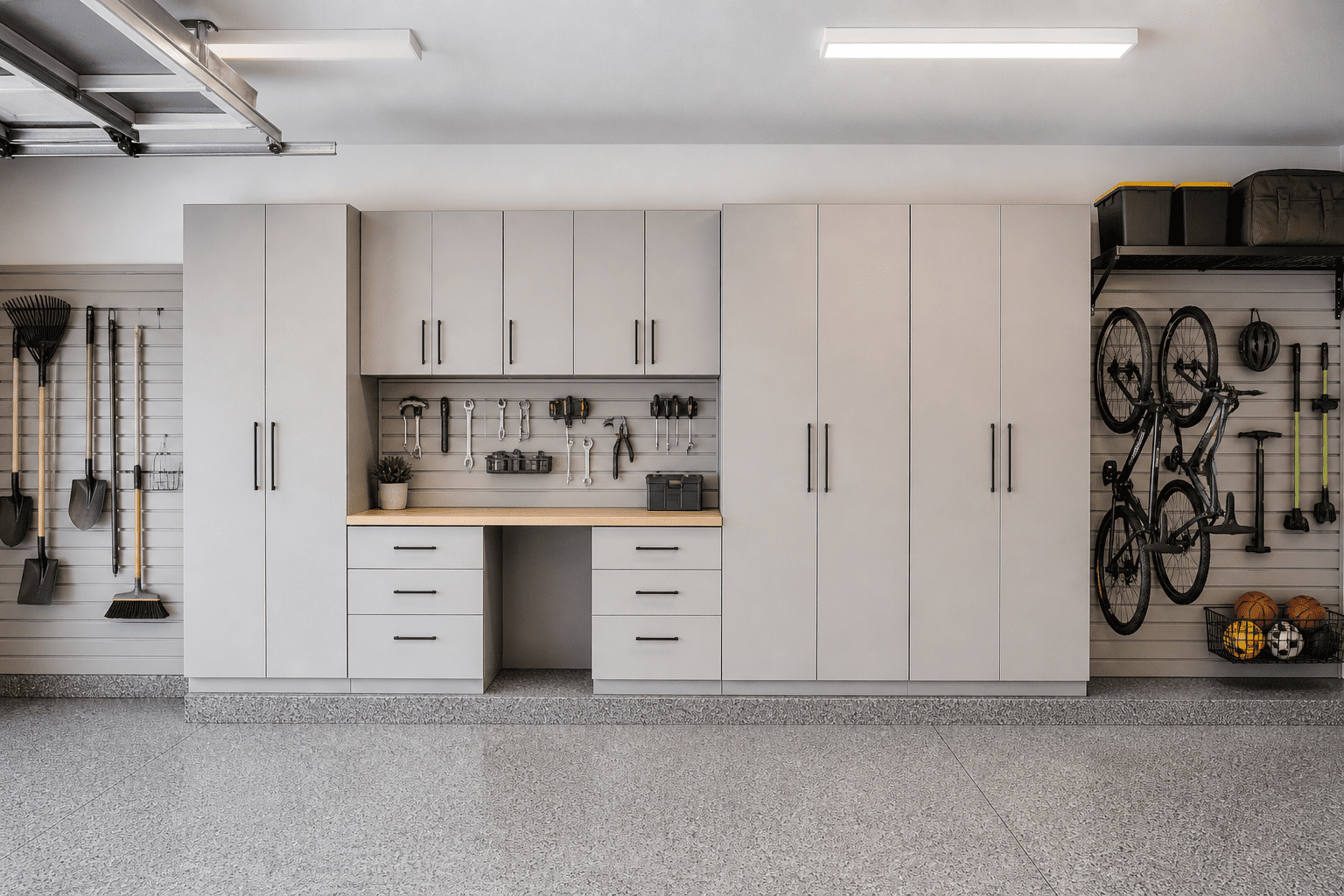
Open the garage door on the first warm Saturday of the year and the same scene plays out across Logan, Hyde Park, Smithfield, Providence, Nibley, North Logan, Richmond, Hyrum, Wellsville, and Mendon: mountain bikes and the lawn mower elbowing each other for floor space, a paddleboard leaning against the wall, the boat hitch waiting for its first Bear Lake run, and last winter’s ski gear still piled in the corner because nobody had anywhere to put it. Garages around here work harder than garages almost anywhere else — year-round — and most of them are not built to keep up.
Custom garage cabinets fix that. Done right, they turn the most-used and least-organized room in the house into a space that actually functions through summers full of hauling gear up Logan Canyon, shoulder seasons of mud and yard work, and five months of snow. After more than 20 years of building cabinetry for Cache Valley homeowners, here is what we have learned about getting garage storage right in this climate.
Why Spring Is the Right Time to Plan a Garage Project
Most homeowners think about garage organization in October, when the snow shovels come back out. By then, every cabinet shop in Northern Utah is booked into the new year. A custom garage cabinet project typically runs 6 to 10 weeks from design through install. Start a conversation in May or June and you have a finished garage well before the first snowfall.
Spring is also when you can actually see what you own — gear is out, the door is open, and the photos and measurements that make a design conversation productive are easy to take.
Why Cache Valley Garages Need Different Cabinets
A garage in Phoenix and a garage in Hyrum are not the same room. Northern Utah garages have to handle conditions — in every season — that destroy lesser cabinetry inside of a few years:
- Big summer toys. Boats and RVs heading to Bear Lake, paddleboards and kayaks for the Logan River, mountain bikes for the canyon trails, ATVs and dirt bikes, plus camping totes and lawn equipment. None of it fits the cheap wire shelving most garages were built with.
- Heavy yard and garden loads. Cache Valley properties tend to be larger than the national norm. That means more shovels, hoses, fertilizer, weed eaters, snowblowers, and seasonal yard tools that all need a real home.
- Freeze-thaw cycles. Most Cache Valley garages are unconditioned. That means swings from 15°F overnight to 65°F when the door is open in afternoon sun. Cheap MDF and particleboard swell, sag, and delaminate.
- Salt and snowmelt. Vehicles drag in road salt, sand, and standing water all winter. Anything sitting on the floor — including base cabinets — ends up soaked at toe-kick height.
- Pole barns and shop spaces. Out in Wellsville, Mendon, and the farm communities south of Logan, the “garage” is often a pole barn or detached shop with even rougher conditions. Those spaces benefit the most from cabinets built to handle them.
What Materials Actually Hold Up in a Northern Utah Garage
If you take only one thing from this post, take this: do not put kitchen-grade cabinets in your garage. They are not built for it, and they will fail faster than you expect. Here is what works:
- Marine-grade or exterior-rated plywood boxes. 3/4” ply with waterproof glue handles humidity swings without warping. This is the foundation of any garage cabinet that lasts.
- Thermofoil or melamine surfaces. Wipe-clean, scratch-tolerant, and immune to the dust and grit that coats every garage by April. Not as warm-looking as wood, but vastly more practical.
- Powder-coated steel hardware. Standard kitchen hinges and slides corrode in cold, damp garages. Powder-coated or stainless hardware adds a few dollars per cabinet and saves a service call in year three.
- Wall-hung base cabinets. Mounting base cabinets six inches off the slab is the single biggest upgrade you can make. Snowmelt rolls under them, the floor stays sweepable, and you stop replacing rotted toe kicks.
How to Lay Out a Garage That Actually Works
Most Cache Valley homeowners we work with start with the same instinct: line one wall with cabinets and call it done. That works for some garages, but the better approach is to think in zones based on what you actually do in the space.
- The drop zone. Just inside the door from the house. Tall lockers with hooks, a bench, and a boot tray catch backpacks, dog leashes, and muddy shoes year-round — and snow gear when winter hits. This is the highest-impact zone in any Cache Valley garage.
- The seasonal-gear wall. Tall, deep cabinets (24” deep instead of the usual 12”) with adjustable shelving handle paddleboard fins, life jackets, camp chairs, ski boots, helmets, and totes of holiday décor as they cycle through the year. Add wall-mounted racks above for vertical storage of paddles, skis, and snowboards.
- The workbench. A 6 to 8 foot run of wall-hung base cabinets with a butcher-block or maple top, plus uppers for power tools and small parts. Even non-DIYers use this space for everything from bike tune-ups to fly tying to small engine repair.
- The yard and garden side. A tall broom-and-tool cabinet keeps rakes, shovels, weed eaters, and snow shovels off the wall hooks where they always fall down. Reserve one cabinet for fertilizer and chemicals, ideally with a key lock if kids are around.
- The big-toy zone. Boat, RV, snowmobile, and ATV households — common from Richmond to Bear Lake — benefit from one purpose-built corner with hooks for helmets and life jackets, racks for gas cans, and a tall locker for off-season gear that swaps in and out twice a year.
The Most-Requested Garage Cabinet Features in Cache Valley
A few specific upgrades come up over and over again on our garage projects from Hyde Park to Providence. They are worth knowing about before you start a design.
- Locking cabinets. For ammunition, power tools, lawn chemicals, or anything else that should not be in casual reach. A simple cam lock adds about $25 per door.
- Pull-out trash and recycling. Two- and three-bin pull-outs keep the bins out of sight and off the garage floor where they get tipped over by every dolly and lawn mower that passes by.
- Slatwall integration. Mounting slatwall in the gaps between cabinet runs lets you hang bikes, paddles, skis, and yard tools without losing cabinet capacity.
- LED under-cabinet lighting. Cache Valley garages get dark fast in winter. Hardwired LED strips under upper cabinets turn the workbench into a usable space year-round.
- Dog-wash or boot-rinse station. An increasingly common request. A small base cabinet with a stainless basin, hand sprayer, and floor drain handles muddy dogs, river-soaked waders, and rinsing fish coolers without dragging them into the laundry room.
New Construction vs. Retrofit: What to Expect
If you are building new in Providence, Nibley, or one of the new subdivisions north of Smithfield, ask your builder to plan for garage cabinets early. A few decisions made during framing make installation cleaner and less expensive:
- Add blocking in the walls. Solid 2×10 blocking behind cabinet locations gives wall-hung cabinets a strong anchor and saves headaches with stud-finding later.
- Run an extra circuit. A dedicated 20-amp outlet at workbench height is one of the cheapest upgrades during rough-in and one of the most expensive to add later.
- Plan a floor drain. If you ever want a wash station, finishing the slab with a small drain saves a full demo down the road.
For retrofits in older Logan and Smithfield homes, the biggest constraints are usually ceiling height and existing electrical. We measure carefully, work around existing utilities, and design cabinetry that fits the actual garage — not a generic 8-foot ceiling assumption.
What to Avoid
- Big-box plastic and wire shelving. Cheap, easy, and will not hold up to the actual loads a Cache Valley garage carries. Most fail within a couple of seasons.
- Recycled kitchen cabinets. It is tempting to throw the old kitchen cabinets in the garage during a remodel. They are not built for unconditioned spaces and will swell, sag, and rust within a few seasons.
- Floor-mounted base cabinets without a sealed toe kick. Even good cabinets will rot from the bottom up if their toe kicks sit in snowmelt all winter.
Ready to Get Your Garage Under Control Before Next Winter?
A well-designed garage is the cheapest square footage you will ever reclaim in your home. We have built garage cabinet packages for everything from a tidy two-car in Hyde Park to a full pole barn in Mendon, and we’ll happily walk through your space and tell you what is realistic for your budget and the way your family actually uses the garage.
Stop by the shop at 50 S Main Street in Hyde Park, Utah, or visit our showroom online to start a project. Bring a few photos of your garage and a list of the gear you are trying to corral — we will take it from there.


