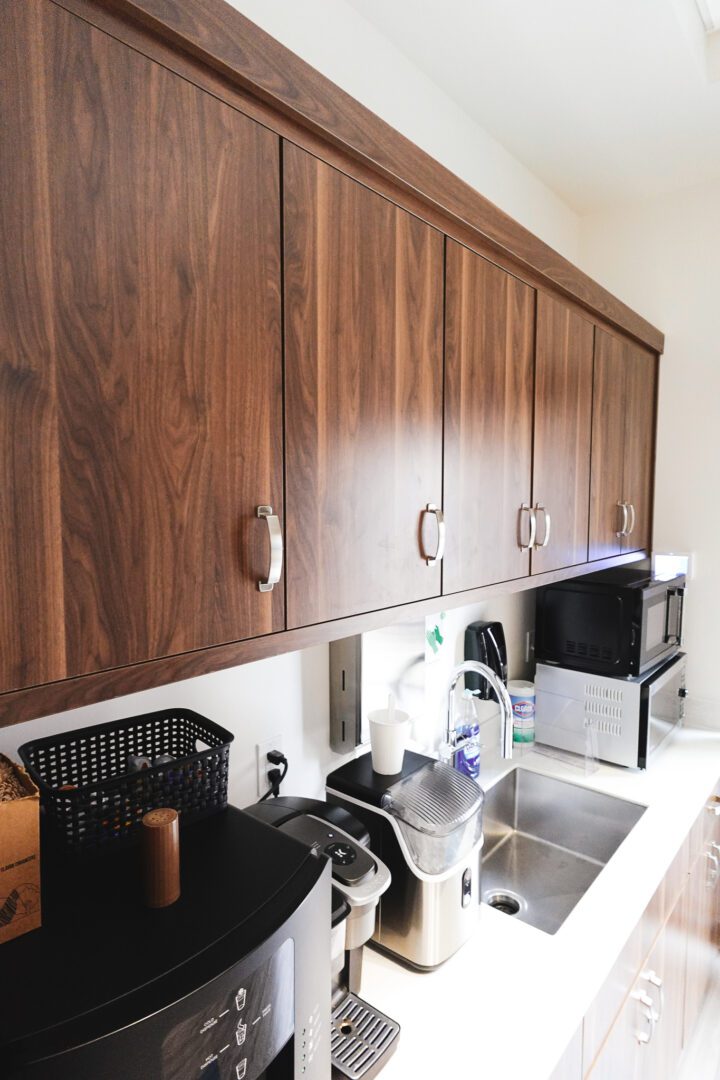
Hiring a cabinet maker is one of the highest-stakes decisions in any kitchen project. The cabinets are the backbone of the room — they outlast appliances, countertops, and usually the homeowner’s patience for the whole remodel. In Cache Valley, where homes range from 1970s splits in Smithfield to brand-new builds in Providence and Hyde Park, the difference between cabinets that look good for thirty years and cabinets that start sagging in three has almost nothing to do with the door style and almost everything to do with what’s hiding behind it.
After 20+ years of building custom cabinetry from our shop at 50 S Main Street in Hyde Park, we’ve seen what holds up in Northern Utah homes and what doesn’t. This guide walks through what real quality looks like — the construction details, the hardware specs, the finish work, and the right questions to ask any cabinet maker before you sign anything.
Why Cabinet Quality Matters More in Cache Valley Than People Realize
Most cabinet buying advice is written for mild, humid climates. Cache Valley is not that. We sit at roughly 4,500 feet of elevation, run hot and dry in summer, and drop into single digits for weeks at a time. Indoor humidity often falls below 25% in January, then climbs again in spring. That seasonal swing makes wood doors and face frames move — sometimes a lot.
On top of that, Cache Valley has notoriously hard water. Minerals build up around sinks and dishwashers, soaking into any cabinet base that isn’t properly sealed and built from materials that can shrug off moisture. Add big LDS-family kitchens that get hammered three meals a day, plus mountain-cabin kitchens at Bear Lake or up Logan Canyon that sit cold and unheated for weeks, and you have a climate that exposes weak construction quickly.
The good news: properly built cabinets handle all of it. The bad news: a lot of what gets sold in this valley is not properly built.
Plywood vs. Particle Board: What’s Actually Inside Your Cabinet Boxes
The box — the carcass — is the part of the cabinet you’ll never see once it’s installed, which is exactly why corner-cutting starts there. There are three common materials, and they are not equivalent.
- 3/4″ plywood. The standard for quality custom work. Holds screws tightly, shrugs off the occasional water leak, and stays dimensionally stable through Cache Valley’s humidity swings. Heavy, expensive, and what we build with at Rivermill.
- Particle board. Compressed wood chips and glue. Once it gets wet — from a dripping garbage disposal, a slow dishwasher leak, or a kid spilling a Yeti — it swells permanently and never recovers. Common in big-box and entry-level “custom” cabinets.
- MDF. A denser, smoother engineered panel. Better than particle board, excellent for painted doors, but still vulnerable to moisture in box construction. Has a place; it isn’t a substitute for plywood on the carcass.
Ask any cabinet maker, in writing, what the boxes are built from. If the answer is vague, the answer is particle board.
Drawer Boxes: Dovetailed Solid Wood Is the Standard You Want
Drawers take more abuse than any other part of a kitchen. They get yanked, slammed, overloaded with cast iron, and opened thousands of times a year. Three things separate a drawer that lasts decades from one that starts wobbling after a Hyrum winter:
- Solid wood sides. Typically 5/8″ or 3/4″ maple or birch. Strong, screws hold, and they tolerate moisture far better than stapled plywood.
- Dovetail joints. Interlocking pins and tails at every corner. They distribute pulling force across the joint instead of relying on a glue line or a couple of staples. Stapled-and-glued drawer boxes are the single most common failure point we see when we tear out old kitchens in Logan, Smithfield, and Wellsville.
- Captured plywood bottoms. The drawer bottom should sit in a groove around all four sides, not be tacked to the underside. A captured bottom keeps the box square for decades.
If a cabinet maker shows you a drawer box that’s stapled, has a tacked-on bottom, or uses thin engineered sides, that’s the level of care going into the rest of the cabinet too.
Soft-Close Hardware and Full-Extension Slides
Hardware is where mid-tier shops quietly downgrade to hit a number. The brands and specs to look for:
- Undermount, full-extension drawer slides. Brands like Blum Tandem or Salice. They carry 75–100 lbs, run smoothly, and let you reach the back of every drawer. Side-mount epoxy slides are the entry-level option you don’t want.
- Soft-close on every door and drawer. Should be standard, not an upcharge.
- Six-way adjustable hinges. Critical in Cache Valley homes where seasonal humidity moves face frames slightly year to year. Adjustable hinges let an installer re-true a door in 30 seconds instead of replacing hardware.
Face Frames, Overlay Style, and Why Construction Matters More Than Door Style
Cache Valley kitchens generally land in one of three overlay styles: partial overlay (older, less common in new builds), full overlay (the dominant modern look — clean reveals between doors), and inset (doors flush with the face frame, more demanding to build). All three can be excellent if the underlying frame is solid hardwood, properly joined, and finished correctly. All three look terrible within a few years if the frame is built from finger-jointed scraps.
A quality face frame is solid hardwood — maple, white oak, alder, hickory — joined with pocket screws or dowels and finished as a single, smooth surface. If a sample feels lightweight or shows visible joint lines through the finish, that’s a tell.
Finish Quality: What Separates a 30-Year Finish from a 5-Year Finish
A great finish is what makes the difference between cabinets that still look new when your kids leave for USU and cabinets you’re already touching up by year three. The non-negotiables:
- Sprayed, catalyzed conversion varnish or 2K finish. Built for kitchens. Resists water, grease, and the cleaning chemicals that hard-water households reach for.
- Sanded between coats. A good cabinet shop sands every coat — usually three to five — before the next goes on. You can feel the difference by running your hand along a door edge.
- Finish on all six sides of every door. If the back of a door is unfinished or has a different sheen, wood movement will be uneven and panels can warp — especially in dry Cache Valley winters.
Questions to Ask Any Cache Valley Cabinet Maker Before You Sign
If you take nothing else from this article, take this list. Print it out and bring it to every quote appointment. The answers will tell you almost everything you need to know.
- What are the cabinet boxes built from? You want to hear “3/4-inch plywood” without hesitation.
- Are the drawer boxes solid wood with dovetail joinery? If the answer is “we use [brand X] dovetail drawers,” ask to see one. Real shops are proud of their drawer boxes.
- What slides and hinges do you use, and is soft-close standard? Blum, Salice, or Grass should come up.
- Do you build the cabinets here, or are you a dealer for someone else? Both can be fine — but you deserve to know.
- Who installs them? Same shop, or a subcontracted crew that’s never seen the cabinets before?
- What’s the finish, and is it sprayed in a finish room? Hand-brushed finishes have no place in a custom kitchen.
- Can you show me a job you finished five or ten years ago? References from a recent install tell you about today; a ten-year-old kitchen tells you whether the work survives Cache Valley weather and family life.
- What’s the warranty, and what does it actually cover? A real lifetime warranty covers materials, joinery, and the finish — not just “manufacturing defects” defined in a way that excludes everything that fails.
What Real Cache Valley Craftsmanship Looks Like
We’ve been building cabinets out of Hyde Park for more than two decades, working with homeowners and local GCs in Logan, North Logan, Smithfield, Richmond, Providence, Nibley, Hyrum, Wellsville, and Mendon, plus cabin projects up Logan Canyon and around Bear Lake. Every box we build is 3/4″ plywood. Every drawer is solid maple with dovetail joinery and a captured plywood bottom. Soft-close Blum hardware is standard on every door and drawer. Every face frame is solid hardwood. Every finish is sprayed and sanded in our own finish room.
That isn’t a premium spec — it’s the baseline. The difference between Rivermill and a lot of what gets sold in this valley isn’t trim or door style or color. It’s that the boring, invisible details are done right, every time, in a kitchen that’s still going to be tight and quiet when the family eating breakfast in it grows up.
If you’re starting a kitchen, vanity, or whole-house project anywhere in Cache Valley, visit our showroom at 50 S Main Street in Hyde Park. Open a drawer, feel a finished door, ask any of the questions above. The answers should match what you read here — and if a cabinet maker can’t answer them clearly, that’s the most useful information of all.