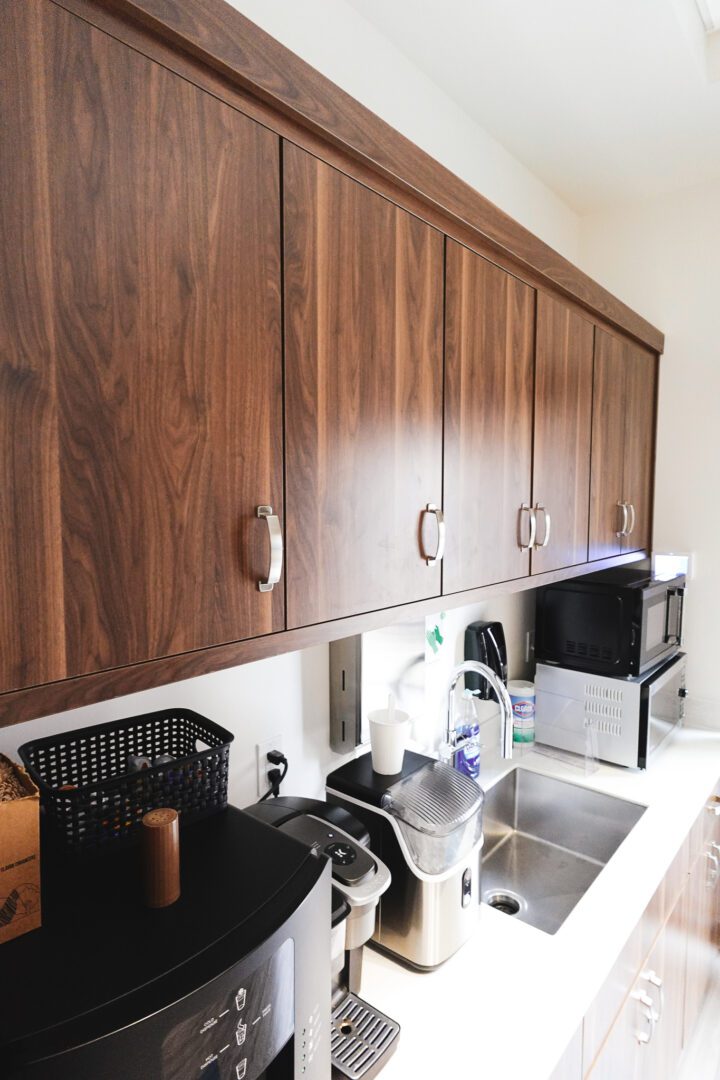
Every winter, we get the same call at our Hyde Park shop: a homeowner notices a thin hairline crack running down a cabinet door panel, or a gap opening up where two pieces of face frame meet. The kitchen looked flawless in October, and by January something has moved. If you live in Cache Valley, this is not a sign your cabinets were built poorly. It is your wood reacting to one of the driest indoor environments in the country. Understanding why it happens is the first step to making sure it never happens to your kitchen.
Do Wood Cabinets Crack in Dry Climates?
Yes, wood cabinets can crack in dry climates, and Cache Valley is exactly the kind of place where it shows up. Wood is a living material even after it is cut and finished. It constantly gives off and takes on moisture to match the air around it. When the surrounding air is humid, wood swells slightly. When the air turns dry, wood shrinks. That movement is small, but across a 15-inch-wide raised panel or a run of cabinets spanning a whole Logan kitchen, small adds up fast.
The problem is not moisture on its own. It is the swing between wet and dry. Our valley delivers one of the widest indoor humidity swings you will find anywhere: damp, cool springs followed by furnace-dried winters where indoor relative humidity can drop well below 20 percent. Solid wood cannot help but respond, and if a cabinet is built without room for that movement, the wood finds relief the only way it can: a crack.
What Cache Valley’s Climate Actually Does to Your Cabinets
Homes in Logan, Providence, Smithfield, and Hyrum share a set of conditions that put more stress on wood than a coastal or Midwest kitchen ever sees. Here is what your cabinets are up against:
- Furnace-dried winter air. From December through February, forced-air heating strips moisture out of the house. Indoor humidity that sits comfortably at 40 to 50 percent in summer can plunge below 20 percent by January, pulling moisture straight out of door panels and face frames.
- A wide seasonal swing. Cache Valley averages roughly 13 inches of rain and 50 inches of snow a year, with humid spring runoff and bone-dry winters. Wood that expands in April and contracts hard in January is being flexed twice a year, every year.
- Altitude and UV exposure. At 4,500 feet and up, the sunlight coming through a south-facing window in North Logan or Nibley carries more UV than it would at sea level. Over time that fades finishes and dries the surface of the wood, which makes cracking more likely on sun-exposed doors.
- Hard water. The mineral-heavy water throughout the valley leaves a chalky film on cabinet surfaces near sinks and dishwashers and can dull a finish faster if it is wiped down with the wrong cleaners.
None of this means you should avoid real wood. It means the cabinet needs to be built and finished for the valley it lives in. That is a design and craftsmanship question, and it is one big-box cabinets shipped in from out of state rarely account for.
The Best Cabinet Wood for a Dry Utah Home
Wood species matters more here than almost anywhere. Harder, denser, more dimensionally stable woods hold up better to the shrink-and-swell cycle. When we talk species with homeowners in our showroom, here is roughly how they stack up for our climate:
- Maple. Hard, tight-grained, and dimensionally stable, maple is one of our most-requested species for Cache Valley kitchens. It takes paint and stain evenly and resists the surface checking that softer woods develop in dry air.
- Hickory. The hardest common domestic cabinet wood. Its density makes it very resistant to dents and cracking, which is why it is a favorite for busy family kitchens in Smithfield and Richmond and for mountain and cabin builds up the canyon.
- Alder. A softer hardwood with a beautiful rustic character. It is a great look, but because it is softer it needs careful construction and a quality finish to stay stable in dry conditions. We are happy to build in alder; we just detail it accordingly.
- Quarter-sawn oak. The way oak is cut changes how it moves. Quarter-sawn boards move less across their width than flat-sawn, making them a smart pick for wide panels in a dry home.
The single most important detail behind all of these is moisture content. We build with wood dried to roughly 6 to 8 percent moisture content and let it acclimate before it becomes a door. Cabinets built from lumber that was never properly dried are the ones that fail first once a Cache Valley furnace kicks on.
How Good Construction Keeps Cabinets From Cracking
Species gets a lot of attention, but construction is what actually prevents cracks. A well-built cabinet is designed to let wood move without splitting. A few of the details that make the difference:
- Floating panel doors. On a five-piece door, the center panel should sit loose inside the frame, not glued in place. That “float” lets the panel shrink and swell freely. Glue that panel down and you have guaranteed a crack the first dry winter.
- Space plus expansion room. We size panels to leave a small gap in the groove so the wood has somewhere to go. It is invisible when the door is finished and essential to how it survives January.
- Plywood cabinet boxes. Furniture-grade plywood boxes stay far more stable than particleboard through humidity swings and hold their joints and hinges better over decades of use.
- A fully sealed finish. A quality catalyzed finish on every surface, including the back of doors and inside edges, slows how fast wood exchanges moisture with the air. It does not stop movement, but it evens it out so the swings are gentler.
These are the details that separate cabinetry built for Cache Valley from cabinets built to a national spec and trucked in. When wood is given room to move, it moves quietly and invisibly. When it is locked in tight, it cracks.
How to Keep Your Cabinets From Cracking
Even the best cabinets last longer when the home works with them. A few simple habits protect your investment through a Wellsville or Mendon winter:
- Aim for 30 to 50 percent indoor humidity. This is the sweet spot for solid wood. A small hygrometer costs very little and tells you exactly where your kitchen sits.
- Run a humidifier in winter. A whole-home humidifier on the furnace, or even a portable unit in the kitchen, keeps the driest months from dropping into cracking territory.
- Wipe hard-water spots with a soft, damp cloth. Skip harsh or ammonia-based cleaners near sinks and dishwashers. Warm water and a dab of mild soap protects the finish that protects the wood.
- Watch the sunny doors. South and west-facing cabinets take the most UV. A sheer or blind on the hardest-hit window slows fading and surface drying.
Questions to Ask Any Cache Valley Cabinet Maker
Whether you build with us or someone else, these questions tell you fast whether a shop understands our climate:
- What moisture content is your lumber dried to? You want a specific number in the 6 to 8 percent range, not a shrug.
- Are your panels glued or floating? Floating is the only right answer for a dry climate.
- Plywood or particleboard boxes? For a home meant to last, plywood earns its keep.
- Is every surface finished, including hidden edges? A fully sealed door is a more stable door.
For more than 20 years, Rivermill Cabinetry & Woodworks has built custom cabinetry for families across Cache Valley, from Richmond and Smithfield down through Logan, Providence, Nibley, and Hyrum. We build for the way our winters actually behave, because we live through them too. If you want cabinets that still look flawless ten dry winters from now, come visit our showroom at 50 S Main Street in Hyde Park, or contact us to talk through your project. We will show you exactly how a cabinet should be built to thrive in a Cache Valley home.