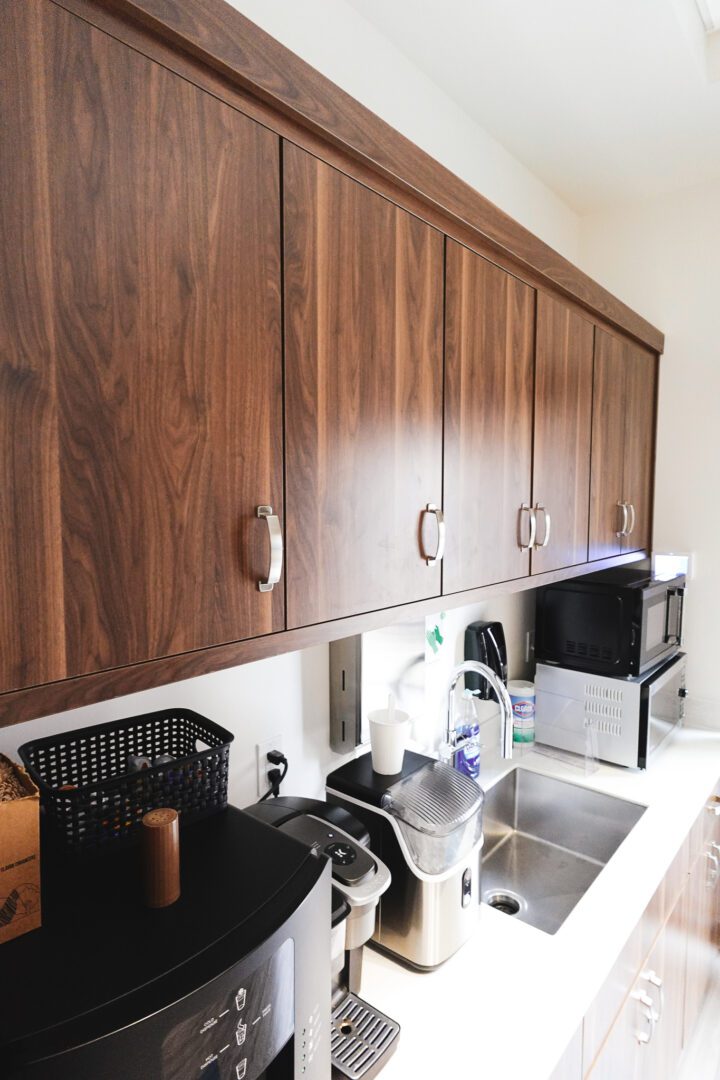
Walk into any home improvement warehouse and you will find a wall of kitchen cabinets that look, at first glance, like a great deal. They are stacked, shrink-wrapped, and ready to load into your truck. For a lot of Cache Valley homeowners, that display is the starting point for a kitchen project. But there is a real difference between grabbing stock boxes off a shelf and having cabinets built for your home by a local shop — and that difference shows up long after the first day of install.
At Rivermill Cabinetry & Woodworks, we have spent more than 20 years building cabinets for homes across Logan, Hyde Park, Smithfield, Providence, Nibley, and the smaller farming towns south and west of the valley. We have also been called in plenty of times to fix or replace big box cabinets that did not hold up. Here is an honest, side-by-side look at what actually separates the two — no sales pitch, just the details that matter once the drawers start getting used every day.
What You Are Really Buying at a Big Box Store
Big box cabinets fall into two buckets: fully assembled stock lines and ready-to-assemble (RTA) boxes that ship flat. Both are built to a price point and to standardized dimensions, which is what makes them fast and consistent. The trade-off is in how they are constructed and how well they adapt to a real room.
- Box material. Most stock cabinet boxes are built from particleboard or thin engineered panels with a laminate skin. Particleboard is sawdust bound with adhesive, and it swells and loses its grip on screws and hinges if it ever meets water — a leaky sink base is all it takes.
- Drawer construction. Budget lines often use stapled or glued drawer boxes rather than dovetailed joints. Under the weight of pans and dishes, those joints are the first thing to loosen.
- Fixed sizes. Stock cabinets come in three-inch increments — 12, 15, 18, 21 inches, and so on. Your kitchen almost never lands on those numbers exactly.
- Finish options. You choose from a short menu of door styles and colors. If you want a specific stain to match existing woodwork or a painted color that is not on the card, you are usually out of luck.
None of this makes big box cabinets useless. For a rental in Logan near USU or a quick flip, they can be the practical call. But for a home you plan to live in for decades, the construction details start to matter a lot.
Why Stock Sizes Fight With Cache Valley Homes
This is the issue we see most often, and it is one nobody warns you about at the warehouse. Cache Valley has a huge range of housing stock, and a lot of it does not play nicely with fixed cabinet sizes.
Drive through Wellsville, Mendon, or Richmond and you will find farmhouses that are a century old, with walls that bow, floors that slope, and corners that are anything but square. Older neighborhoods in Smithfield and Hyrum are full of 1960s and 1970s homes with quirky galley layouts. When you set standardized boxes into rooms like these, you end up bridging the leftover space with filler strips — blank panels that fill the gap between the last cabinet and the wall.
Say a wall runs 95 inches. Two 30-inch cabinets and a 30-inch sink base only cover 90 of them, so five inches gets eaten by filler. That is storage you paid for in floor space but will never actually use — no drawer, no pull-out, just a dead panel. In a crooked farmhouse it gets worse, because the installer has to scribe and shim to hide the gaps, and the seams still tend to show.
When we build cabinets for a home in Providence or a remodel in Nibley, we measure the actual room and build to it. A 95-inch wall gets 95 inches of cabinetry. That reclaimed space usually becomes a spice pull-out, a tray divider, or a wider drawer bank — real function instead of a filler board.
How Cache Valley’s Dry Climate Changes the Equation
Northern Utah is high, dry, and hard on wood and finishes. Logan sits around 4,500 feet, and our winters pull indoor humidity down into single digits for weeks at a time. That environment does two things to cabinets.
- It punishes cheap materials. Particleboard and thin veneers expand and contract with humidity swings, and over years of dry winters and swamp-cooler summers, edges lift and laminate peels. Solid wood and quality plywood boxes handle the cycling far better.
- It shows every finish flaw. Our hard water and dry air are unforgiving on finishes. A properly sealed, catalyzed finish resists water spotting and checking; a thin factory topcoat does not always hold up the same way.
A local shop builds and finishes for these exact conditions. We know what a January in North Logan does to a door panel, so we account for wood movement and choose finishes that survive it. A cabinet engineered for a humid climate in another state is not tuned for the valley.
Design Help: On Your Own vs. Sitting Down With a Designer
At a big box store, layout is largely your job. There may be a designer on a rotating shift, but they are often part-time and juggling many customers, and once your order ships the relationship is basically over. If a cabinet arrives damaged or a part is missing, you are back in the returns line.
Working with a local cabinet maker looks different from the first conversation. When a family in Hyde Park or Smithfield comes into our showroom, we sit down and work through how they actually use their kitchen — whether they bulk-buy and need deep pantry storage, whether the mudroom takes a beating from boots and snow gear, whether grandkids are always at the island. Then we design around that. And because our shop is right here in the valley, we are a phone call away for years afterward if something needs adjusting.
Questions to Ask Before You Buy Any Cabinet
Whether you are leaning toward a warehouse or a local shop, these questions cut through the sales talk and tell you what you are really getting:
- What is the box made of? Plywood boxes hold screws and resist moisture far better than particleboard.
- How are the drawers joined? Dovetailed solid-wood drawer boxes outlast stapled or glued ones by years.
- Can it be built to my exact measurements? If the answer is “we round to the nearest three inches,” expect fillers and wasted space.
- Who handles it if something goes wrong? A local shop stands behind its work in person; a warehouse points you to a return counter.
- What hardware is included? Soft-close hinges and full-extension glides should be standard, not an upcharge.
Ask those five questions at a big box counter and a local shop, and the gap between the two becomes obvious.
When Big Box Makes Sense — and When It Does Not
We are not going to pretend stock cabinets never have a place. If you are outfitting a garage workspace, a basement kitchenette, or a short-term rental where longevity is not the priority, off-the-shelf boxes can do the job. Plenty of general contractors and builders around the valley use them for exactly those situations.
But if this is your primary kitchen, a new build in Providence or North Logan, or a remodel of an older home in Smithfield, Hyrum, or one of the farm towns where the walls were never square to begin with, cabinets built for the space will fit better, work harder, and last far longer. That is the difference between buying a product and having something made for your house.
See the Difference in Person
The easiest way to understand the gap is to open the drawers yourself. Our showroom at 50 S Main Street in Hyde Park has more than 20 full kitchen and bath displays, along with finish and hardware samples you can put your hands on. Pull a dovetailed drawer, feel a plywood box, and compare it to what ships flat-packed from a warehouse — the difference is immediate.
For over two decades, Rivermill Cabinetry & Woodworks has built cabinets for families across Cache Valley, from Logan and Hyde Park to Nibley, Mendon, Richmond, and Wellsville. If you are weighing your options for a kitchen, mudroom, or bath, visit our showroom and let us show you what cabinets built for your home actually look like.